
BioAssay Systems
SKU(재고 관리 코드):ECAT-100
EnzyChrom™ Catalase Assay Kit
EnzyChrom™ Catalase Assay Kit
Application
- For quantitative determination of catalase activity and evaluation of drug effects on catalase activity.
Key Features
- Sensitive and accurate. Use 10 µL sample. Linear detection range 0.2 to 5 U/L catalase activity.
- Simple and Convenient. The procedure involves adding a Substrate to the sample, incubation for 30 min, followed by a Detection Reagent and reading the optical density or fluorescence intensity.
Method
- OD570nm, or FL530/585nm
Samples
- Serum, plasma, urine, saliva, cell culture etc
Species
- All
Procedure
- 40 min
Size
- 100 tests
Detection Limit
- 0.2 U/L
Shelf Life
- 6 months
More Details
CATALASE (EC 1.11.1.6), is an ubiquitous antioxidant enzyme that catalyzes the decomposition of hydrogen peroxide (H2O2) to water and oxygen. By preventing excessive H2O2 build-up, catalase allows important cellular processes which produce H2O2 as a byproduct to occur safely. Deficiency in catalase activity has been associated with grey hair and peroxisomal disorder acatalasia. Simple, direct and high-throughput assays for catalase activity find wide applications. BioAssay Systems improved assay directly measures catalase degradation of H2O2 using a redox dye. The change in colour intensity at 570nm or fluorescence intensity (λex/em = 530/585nm) is directly proportional to the catalase activity in the sample.
Regarding the technique used in the DPOD-100 peroxidase assay and the ECAT-100 catalase assay that seems to be really similar, how will we be sure that one of them will measure the catalase activity and the other the peroxidase?
The DPOD assay measures the conversion of the dye reagent and hydrogen peroxide, which are provided in large excess as substrates for cellular peroxidases. Endogenous catalase activity does not interfere with the assay, because it does not react with the dye reagent, hydrogen peroxide is in large excess, and the reaction is short (10 minutes), leaving the H2O2 concentration practically unchanged.
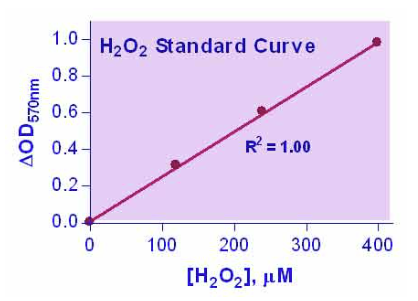
The ECAT assays measures catalase activity by first incubating much lower concentrations of hydrogen peroxide with the samples for 30 minutes. Then the decrease in hydrogen peroxide is measured by adding the dye reagent and HRP in excess.
You will have 100 µL of each standard when you have pipetted all solutions for the standard curve. How stable are the 100 µl standards? Can they be used the next day to make another standard curve or can the values from the already made standard curve be used when you have other samples the next day?
The H2O2 standards are stable for an hour. Therefore assays should be run as soon as possible with the samples and standards. It is recommended that customers run standard curve in each experiment.
Share