

Cloud-clone
SKU(재고 관리 코드):APC823Hu01
Active Thymidine Kinase 1, Soluble (TK1)
Active Thymidine Kinase 1, Soluble (TK1)
Product No.
APC823Hu01
Organism Species
Homo sapiens (Human).
Buffer Formulation
PBS, pH7.4, containing 0.01% SKL, 5% Trehalose.
Traits
Freeze-dried powder
Purity
> 95%
Isoelectric Point
8.9
Applications
Cell culture; Activity Assays.
UOM
10µg 50µg 200µg 1mg 5mg
ACTIVITY TEST
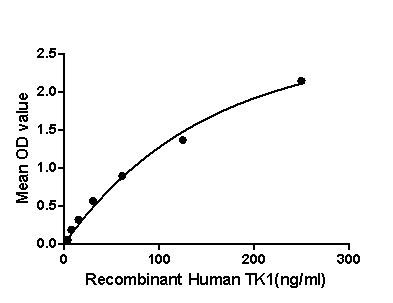
Figure. The binding activity of TK1 with GAPDH.
Thymidine kinase 1 (TK1), is a human thymidine kinase. Thymidine kinase has been making a growing impact in the cancer research community. It has been found that elevated blood serum levels of TK-1 correlates with metastatic capabilities of the cancer and thereby can be used to detect malignant types of cancer, furthermore TK-1 has been found to show up in blood serum even before clinical symptoms even start to show. Besides, Glyceraldehyde 3-phosphate dehydrogenase (GAPDH) has been identified as an interactor of TK1, thus a binding ELISA assay was conducted to detect the interaction of recombinant human TK1 and recombinant human GAPDH. Briefly, TK1 were diluted serially in PBS, with 0.01% BSA (pH 7.4). Duplicate samples of 100uL were then transferred to GAPDH-coated microtiter wells and incubated for 2h at 37℃. Wells were washed with PBST and incubated for 1h with anti-TK1 pAb, then aspirated and washed 3 times. After incubation with HRP labelled secondary antibody, wells were aspirated and washed 3 times. With the addition of substrate solution, wells were incubated 15-25 minutes at 37℃. Finally, add 50µL stop solution to the wells and read at 450nm immediately. The binding activity of TK1 and GAPDH was shown in Figure 1, and this effect was in a dose dependent manner.
USAGE
Reconstitute in 10mM PBS (pH7.4) to a concentration of 0.1-1.0 mg/mL. Do not vortex.
STORAGE
Avoid repeated freeze/thaw cycles. Store at 2-8°C for one month. Aliquot and store at -80°C for 12 months.
STABILITY
The thermal stability is described by the loss rate. The loss rate was determined by accelerated thermal degradation test, that is, incubate the protein at 37°C for 48h, and no obvious degradation and precipitation were observed. The loss rate is less than 5% within the expiration date under appropriate storage condition.
| Magazine | Citations |
| Mol Imaging Biol | Evaluation of [18F] Fluorothymidine as a Biomarker for Early Therapy Response in a Mouse Model of Colorectal Cancer Pubmed:27324368 |
| Molecular Imaging and Biology | Evaluation of [18F]Fluorothymidine as a Biomarker for Early Therapy Response in a Mouse Model of Colorectal Cancer pubmed:27324368 |
