

Cloud-clone
SKU(재고 관리 코드):APA928Ra01
Active Tumor Protein p53 (P53)
Active Tumor Protein p53 (P53)
Product No.
APA928Ra01
Organism Species
Rattus norvegicus (Rat).
Buffer Formulation
20mM Tris, 150mM NaCl, pH8.0, containing 1mM EDTA, 1mM DTT, 0.01% SKL, 5% Trehalose and Proclin300.
Traits
Freeze-dried powder
Purity
> 97%
Isoelectric Point
9.0
Applications
Cell culture; Activity Assays.
UOM
10µg 50µg 200µg 1mg 5mg
ACTIVITY TEST
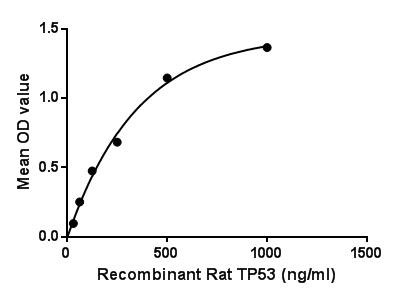
Tumor protein p53 (TP53), also known as p53, cellular tumor antigen p53 has many mechanisms of anticancer function and plays a role in apoptosis, genomic stability, and inhibition of angiogenesis. TP53 act as a tumor suppressor in many tumor types; induces growth arrest or apoptosis depending on the physiological circumstances and cell type. It also Involved in cell cycle regulation as a trans-activator that acts to negatively regulate cell division by controlling a set of genes required for this process. Besides, CREB Binding Protein (CREBBP) has been identified as an interactor of TP53, thus a binding ELISA assay was conducted to detect the interaction of recombinant rat TP53 and recombinant rat CREBBP. Briefly, TP53 were diluted serially in PBS, with 0.01% BSA (pH 7.4). Duplicate samples of 100μL were then transferred to CREBBP-coated microtiter wells and incubated for 2h at 37℃. Wells were washed with PBST and incubated for 1h with anti-TP53 pAb, then aspirated and washed 3 times. After incubation with HRP labelled secondary antibody, wells were aspirated and washed 3 times. With the addition of substrate solution, wells were incubated 15-25 minutes at 37℃. Finally, add 50µL stop solution to the wells and read at 450nm immediately. The binding activity of TP53 and CREBBP was shown in Figure 1, and this effect was in a dose dependent manner.
Figure. The binding activity of TP53 with CREBBP.
USAGE
Reconstitute in 20mM Tris, 150mM NaCl (pH8.0) to a concentration of 0.1-1.0 mg/mL. Do not vortex.
STORAGE
Avoid repeated freeze/thaw cycles. Store at 2-8°C for one month. Aliquot and store at -80°C for 12 months.
STABILITY
The thermal stability is described by the loss rate. The loss rate was determined by accelerated thermal degradation test, that is, incubate the protein at 37°C for 48h, and no obvious degradation and precipitation were observed. The loss rate is less than 5% within the expiration date under appropriate storage condition.
| Magazine | Citations |
| Anticancer Research | Analysis of p53 and miRNA expression after irradiation of glioblastoma cell lines PubMed: 23155233 |
| Microscopy Research and Technique | Therapeutic role of curcumin in oxidative DNA damage caused by formaldehyde PubMed: 25761397 |
| J Nutr Biochem | Supplementation with Selenium yeast on the prooxidant–antioxidant activities and anti-tumor effects in breast tumor xenograft-bearing mice PubMed: 26344777 |
| Biochemical and Biophysical Research Communications | Transcription factor HBP1: A regulator of senescence and apoptosis of preadipocytes Pubmed: 31331641 |
| Folia Biologica | Effect of Graviola (Annona Muricata l.) and Ginger (Zingiber Officinale Roscoe) on Diabetes Mellitus Induced in Male Wistar Albino Rats |
| Non-POU Domain-Containing Octamer-Binding (NONO) Protein Stability Regulated by PIN1 is Crucial for Breast Cancer Tumorigenicity Via the MAPK/β … |
| Catalog No. | Related products for research use of Rattus norvegicus (Rat) Organism species | Applications (RESEARCH USE ONLY!) |
| RPA928Ra01 | Recombinant Tumor Protein p53 (P53) | Positive Control; Immunogen; SDS-PAGE; WB. |
| APA928Ra01 | Active Tumor Protein p53 (P53) | Cell culture; Activity Assays. |
| PAA928Ra01 | Polyclonal Antibody to Tumor Protein p53 (P53) | WB,ICC/IF |
| MAA928Ra22 | Monoclonal Antibody to Tumor Protein p53 (P53) | WB; IHC; ICC; IP. |
| MAA928Ra21 | Monoclonal Antibody to Tumor Protein p53 (P53) | WB; IHC; ICC; IP. |
| SEA928Ra | ELISA Kit for Tumor Protein p53 (P53) | Enzyme-linked immunosorbent assay for Antigen Detection. |
| LMA928Ra | Magnetic Luminex Assay Kit for Tumor Protein p53 (P53) ,etc. | Magnetic Luminex Assay for Antigen Detection. |
