
FineTest
SKU(재고 관리 코드):FNab02913
anti- EYA1 antibody
anti- EYA1 antibody
가격·납기 및 기술자료를 확인해 드립니다.
제품 규격과 수량을 선택한 후 견적을 요청해 주세요. 대체품 검토와 SDS·COA·데이터시트 요청도 함께 접수할 수 있습니다.
이 제품 견적 요청Step into the world of developmental biology and signaling with our Anti-EYA1 Antibody, an essential tool for investigating EYA1's role in organogenesis and tissue-specific processes. EYA1 is known for its involvement in cellular development and signaling pathways, making it a central target for researchers exploring developmental biology and disease mechanisms. This high-quality antibody, available in a 100µg size, is your trusted partner in unraveling the intricacies of EYA1's functions.
Our meticulously developed and rigorously validated Anti-EYA1 Antibody ensures exceptional specificity and sensitivity, providing you with reliable and accurate results in your research. Whether you're studying organ development, signaling pathways, or other aspects of cellular function, this antibody offers versatility and high performance.
The 100µg size minimizes the need for frequent reordering, allowing you to focus more on your research and less on supply management. Whether you're working with tissue samples, cell cultures, or other experimental systems, this antibody seamlessly adapts to a wide range of research applications.
Product Name
EYA1 antibody
Size
100µg
Form
liquid
Purification
Immunogen affinity purified
Purity
≥95% as determined by SDS-PAGE
Host
Rabbit
Clonality
polyclonal
Isotype
IgG
Storage
PBS with 0.02% sodium azide and 50% glycerol pH 7.3, -20℃ for 12 months(Avoid repeated freeze / thaw cycles.)
BACKGROUND
Functions both as protein phosphatase and as transcriptional coactivator for SIX1, and probably also for SIX2, SIX4 and SIX5(By similarity). Tyrosine phosphatase that dephosphorylates 'Tyr-142' of histone H2AX(H2AXY142ph) and promotes efficient DNA repair via the recruitment of DNA repair complexes containing MDC1. 'Tyr-142' phosphorylation of histone H2AX plays a central role in DNA repair and acts as a mark that distinguishes between apoptotic and repair responses to genotoxic stress(PubMed:19234442). Its function as histone phosphatase may contribute to its function in transcription regulation during organogenesis(By similarity). Has also phosphatase activity with proteins phosphorylated on Ser and Thr residues(in vitro)(By similarity). Required for normal embryonic development of the craniofacial and trunk skeleton, kidneys and ears(By similarity). Together with SIX1, it plays an important role in hypaxial muscle development; in this it is functionally redundant with EYA2(By similarity).
IMMUNOGEN INFORMATION
Immunogen
eyes absent homolog 1(Drosophila)
Observed MW
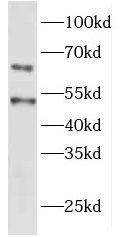
60 kDa ;50 kDa
APPLICATION
Tested Application
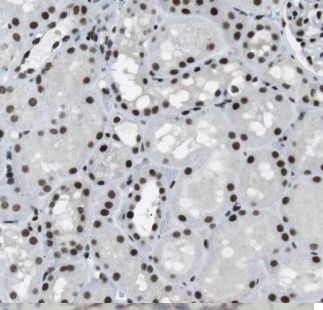
ELISA, IHC, WB, IF
Recommended Dilution
WB: 1:500-1:2000; IHC: 1:20-1:200; IF: 1:20-1:200
UNIPROT INFORMATION
UniProt ID
IMAGES