
FineTest
SKU(재고 관리 코드):FNab03102
anti- FGFR2 antibody
anti- FGFR2 antibody
Delve into the intricate world of Fibroblast Growth Factor Receptor 2 (FGFR2) with our Anti-FGFR2 Antibody, available in a 100µg vial. FGFR2 is a vital member of the FGFR family, known for its involvement in cell growth and tissue development. This highly specific antibody empowers researchers to investigate the role of FGFR2 in various biological contexts with precision and reliability.
Key Features:
- High Specificity: Our Anti-FGFR2 Antibody is rigorously tested to ensure it accurately targets FGFR2, reducing the risk of cross-reactivity.
- Versatile Applications: Ideal for a wide range of experimental techniques, including Western blotting, immunoprecipitation, and immunohistochemistry.
- Ample Quantity: With 100µg, you have a generous supply for multiple experiments.
- Top-Tier Quality: Manufactured to the highest industry standards, guaranteeing consistent and reproducible results.
- Advance Your Research: Whether you're exploring cell growth regulation, tissue development, or cancer biology, our Anti-FGFR2 Antibody is your key to unlocking new knowledge.
Uncover the role of FGFR2 in complex biological processes and elevate your research with our Anti-FGFR2 Antibody.
Product Name
FGFR2 antibody
Size
100µg
Form
liquid
Purification
Immunogen affinity purified
Purity
≥95% as determined by SDS-PAGE
Host
Rabbit
Clonality
polyclonal
Isotype
IgG
Storage
PBS with 0.02% sodium azide and 50% glycerol pH 7.3, -20℃ for 12 months(Avoid repeated freeze / thaw cycles.)
BACKGROUND
Tyrosine-protein kinase that acts as cell-surface receptor for fibroblast growth factors and plays an essential role in the regulation of cell proliferation, differentiation, migration and apoptosis, and in the regulation of embryonic development. Required for normal embryonic patterning, trophoblast function, limb bud development, lung morphogenesis, osteogenesis and skin development. Plays an essential role in the regulation of osteoblast differentiation, proliferation and apoptosis, and is required for normal skeleton development. Promotes cell proliferation in keratinocytes and immature osteoblasts, but promotes apoptosis in differentiated osteoblasts. Phosphorylates PLCG1, FRS2 and PAK4. Ligand binding leads to the activation of several signaling cascades. Activation of PLCG1 leads to the production of the cellular signaling molecules diacylglycerol and inositol 1,4,5-trisphosphate. Phosphorylation of FRS2 triggers recruitment of GRB2, GAB1, PIK3R1 and SOS1, and mediates activation of RAS, MAPK1/ERK2, MAPK3/ERK1 and the MAP kinase signaling pathway, as well as of the AKT1 signaling pathway. FGFR2 signaling is down-regulated by ubiquitination, internalization and degradation. Mutations that lead to constitutive kinase activation or impair normal FGFR2 maturation, internalization and degradation lead to aberrant signaling. Over-expressed FGFR2 promotes activation of STAT1.
IMMUNOGEN INFORMATION
Immunogen
fibroblast growth factor receptor 2
Synonyms
BEK, KGFR, KSAM
Observed MW
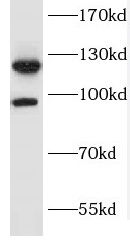
120 kDa, 85-92 kDa
APPLICATION
Tested Application
ELISA, WB, IF
Recommended Dilution
WB: 1:500-1:2000; IF: 1:20-1:200
UNIPROT INFORMATION
UniProt ID
IMAGES