
NSJ Bioreagents
SKU(재고 관리 코드):FY13432
EIF3D Antibody / Eukaryotic translation initiation factor 3 subunit D, 100ug
EIF3D Antibody / Eukaryotic translation initiation factor 3 subunit D, 100ug
가격·납기 및 기술자료를 확인해 드립니다.
제품 규격과 수량을 선택한 후 견적을 요청해 주세요. 대체품 검토와 SDS·COA·데이터시트 요청도 함께 접수할 수 있습니다.
이 제품 견적 요청대표번호 070-8028-3500 · info@rndmate.com
EIF3D antibody targets Eukaryotic translation initiation factor 3 subunit D, encoded by the EIF3D gene. EIF3D is a cytoplasmic protein that functions as a component of the eukaryotic translation initiation factor 3 (eIF3) complex, a central regulator of translation initiation. The eIF3 complex associates with the 40S ribosomal subunit and coordinates recruitment of mRNA and initiator tRNA during early steps of protein synthesis. EIF3D contributes to assembly and stability of this multiprotein complex and supports efficient translation initiation in eukaryotic cells.<br><br>Functionally, Eukaryotic translation initiation factor 3 subunit D plays a role in regulating mRNA translation rather than acting as a general enzymatic factor. EIF3D has been implicated in selective translation of specific mRNA subsets, linking translational control to cellular growth, stress responses, and differentiation. Through its participation in the eIF3 complex, EIF3D influences translation efficiency and fidelity, allowing cells to adapt protein synthesis programs to changing physiological conditions. An EIF3D antibody supports studies focused on translational regulation and ribosome-associated signaling.<br><br>EIF3D is broadly expressed across tissues and cell types, reflecting the universal requirement for regulated protein synthesis. Its activity is particularly relevant in proliferative cells, where tight control of translation initiation is essential for growth and cell cycle progression. EIF3D can interact with other eIF3 subunits and translation-associated factors, positioning it as part of a dynamic network that integrates signaling pathways with translational output.<br><br>From a disease-relevance perspective, altered EIF3D expression or function has been investigated in cancer and other disorders characterized by dysregulated protein synthesis. Changes in translation initiation factor activity can contribute to abnormal cell growth, survival, and stress adaptation. EIF3D has therefore emerged as a protein of interest in studies examining how translational control mechanisms influence disease-associated cellular behavior.<br><br>At the molecular level, Eukaryotic translation initiation factor 3 subunit D contains conserved regions required for interaction with ribosomal subunits and other components of the eIF3 complex. Post-translational modifications and complex assembly state - without altering the primary amino acid sequence - can influence its apparent behavior in biochemical assays. EIF3D antibody reagents support research applications focused on translation initiation, ribosome biology, and disease-associated alterations in protein synthesis, with NSJ Bioreagents providing reagents intended for research use.
Specifications
| Catalog No | FY13432 |
|---|---|
| Family | Primary antibody |
| Qty | 100ug |
| Formulation | Adding 0.2 ml of distilled water will yield a concentration of 500 ug/ml |
| Format | Lyophilized |
| Host Animal | Rabbit |
| Clonality | Polyclonal (rabbit origin) |
| Isotype | Rabbit IgG |
| Species Reactivity | Human, Rat |
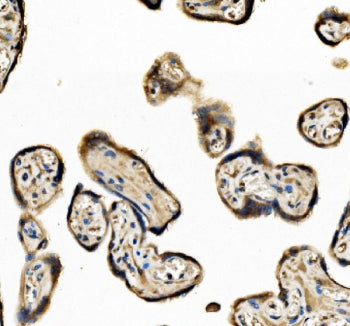
| Application | WB, IHC, ELISA |
| Application Details | Western Blot: 0.25-0.5ug/ml,Immunohistochemistry (FFPE): 2-5ug/ml,ELISA: 0.1-0.5ug/ml |
| Application Note | Optimal dilution of the EIF3D antibody should be determined by the researcher. |
| Status | Available |
| PDF Link | Product Data Sheet (PDF) |
| Buffer | Each vial contains 4 mg Trehalose, 0.9 mg NaCl and 0.2 mg Na2HPO4. |
| Limitation | This EIF3D antibody is available for research use only. |
| Uniprot # | O15371 |
| Purity | Immunogen affinity purified |
| Immunogen | E.coli-derived human Eukaryotic translation initiation factor 3 subunit D recombinant protein (amino acids I319-D532) was used as the immunogen for the EIF3D antibody. |
| Storage | After reconstitution, the EIF3D antibody can be stored for up to one month at 4oC. For long-term, aliquot and store at -20oC. Avoid repeated freezing and thawing. |
| Title | EIF3D Antibody / Eukaryotic translation initiation factor 3 subunit D |
Share