
NSJ Bioreagents
SKU(재고 관리 코드):FY13434
DKK3 Antibody / Dickkopf-related protein 3, 100ul
DKK3 Antibody / Dickkopf-related protein 3, 100ul
가격·납기 및 기술자료를 확인해 드립니다.
제품 규격과 수량을 선택한 후 견적을 요청해 주세요. 대체품 검토와 SDS·COA·데이터시트 요청도 함께 접수할 수 있습니다.
이 제품 견적 요청대표번호 070-8028-3500 · info@rndmate.com
DKK3 antibody targets Dickkopf-related protein 3, encoded by the DKK3 gene. DKK3 is a secreted glycoprotein belonging to the Dickkopf family, a group of proteins originally identified as modulators of Wnt signaling. Unlike other Dickkopf family members, DKK3 does not function as a classical Wnt antagonist and instead exhibits context-dependent regulatory roles in cell signaling, differentiation, and tissue homeostasis. DKK3 is synthesized intracellularly and secreted into the extracellular space, where it can influence cell-cell communication.<br><br>Functionally, Dickkopf-related protein 3 has been implicated in regulation of cell proliferation, apoptosis, and differentiation. DKK3 activity appears to depend on cellular context and tissue type, with reported involvement in modulation of growth factor signaling pathways and stress-responsive cellular programs. Through these mechanisms, DKK3 contributes to maintenance of normal tissue architecture and regulation of cellular responses to environmental cues. A DKK3 antibody supports studies focused on extracellular signaling and regulatory protein function.<br><br>DKK3 expression is detected in a variety of tissues, including epithelial and stromal compartments. It is often associated with differentiated cell states and has been reported to localize both intracellularly during synthesis and extracellularly following secretion. Changes in DKK3 expression levels have been linked to alterations in cellular differentiation status and signaling balance.<br><br>From a disease-relevance perspective, DKK3 has been widely studied in cancer biology. Reduced or altered DKK3 expression has been reported in multiple tumor types and is frequently associated with tumor progression, invasion, and poor prognosis. DKK3 has therefore been proposed as a tumor suppressor-associated protein and a potential biomarker for disease state and therapeutic response. These associations make DKK3 an important target for research into cancer-related signaling pathways.<br><br>At the molecular level, Dickkopf-related protein 3 contains conserved cysteine-rich domains characteristic of the Dickkopf family, which support protein folding and extracellular interactions. Post-translational modifications and secretion dynamics can influence its apparent behavior in biochemical assays. DKK3 antibody reagents support research applications focused on cell signaling, tumor biology, and extracellular regulatory mechanisms, with NSJ Bioreagents providing reagents intended for research use.
Specifications
| Catalog No | FY13434 |
|---|---|
| Family | Primary antibody |
| Qty | 100ul |
| Formulation | Rabbit IgG in phosphate buffered saline, pH 7.4, 150mM NaCl, 0.02% sodium azide and 50% glycerol, 0.4-0.5mg/ml BSA |
| Format | Purified |
| Clone | 21D17 |
| Host Animal | Rabbit |
| Clonality | Recombinant Rabbit Monoclonal |
| Isotype | Rabbit IgG |
| Species Reactivity | Human, Mouse, Rat |
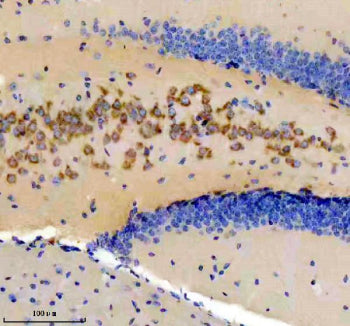
| Application | WB, IHC-P |
| Application Details | Western blot: 1:500-1:2000,Immunohistochemistry: 1:50-1:200 |
| Application Note | Optimal dilution of the DKK3 antibody should be determined by the researcher. |
| Status | Available |
| PDF Link | Product Data Sheet (PDF) |
| Buffer | Rabbit IgG in phosphate buffered saline, pH 7.4, 150mM NaCl, 0.02% sodium azide and 50% glycerol, 0.4-0.5mg/ml BSA. |
| Limitation | This DKK3 antibody is available for research use only. |
| Uniprot # | Q9UBP4 |
| Purity | Purified |
| Immunogen | A synthesized peptide derived from human Dickkopf-related protein 3 was used as the immunogen for the DKK3 antibody. |
| Storage | After reconstitution, the DKK3 antibody can be stored for up to one month at 4oC. For long-term, aliquot and store at -20oC. Avoid repeated freezing and thawing. |
| Localization | Cytoplasm |
| Title | DKK3 Antibody / Dickkopf-related protein 3 |
Share