Western Blot: 1/500 - 1/2000. Immunohistochemistry: 1/100 - 1/300. ELISA: 1/20000. Not yet tested in other applications.
Immunogen:
The antiserum was produced against synthesized peptide derived from human p18 INK. AA range:111-160
Storage:
Rabbit
Storage:
-20°C/1 year
Clonality:
Polyclonal
Isotype:
IgG
Concentration:
1 mg/ml
Observed Band:
18kD
GeneID(Human):
1031
Human Swiss-Prot No:
P42773
Cellular localization:
nucleus,cytoplasm,cytosol,
Background:
The protein encoded by this gene is a member of the INK4 family of cyclin-dependent kinase inhibitors. This protein has been shown to interact with CDK4 or CDK6, and prevent the activation of the CDK kinases, thus function as a cell growth regulator that controls cell cycle G1 progression. Ectopic expression of this gene was shown to suppress the growth of human cells in a manner that appears to correlate with the presence of a wild-type RB1 function. Studies in the knockout mice suggested the roles of this gene in regulating spermatogenesis, as well as in suppressing tumorigenesis. Two alternatively spliced transcript variants of this gene, which encode an identical protein, have been reported. [provided by RefSeq, Jul 2008],


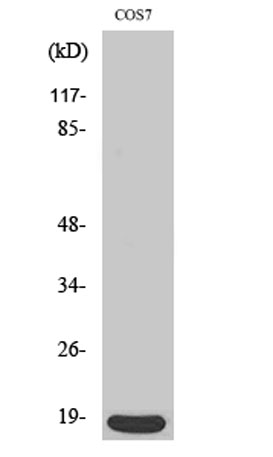 Western Blot analysis of various cells using p18 Polyclonal Antibody
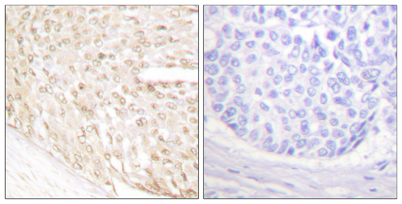 Immunohistochemistry analysis of paraffin-embedded human breast carcinoma tissue, using p18 INK Antibody. The picture on the right is blocked with the synthesized peptide.
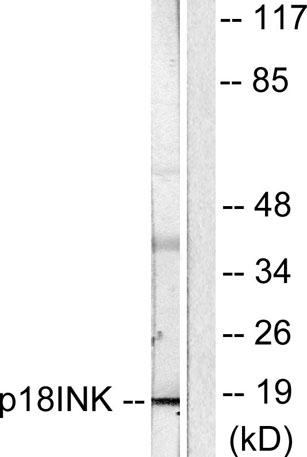 Western blot analysis of lysates from COS7 cells, using p18 INK Antibody. The lane on the right is blocked with the synthesized peptide.