
Elabscience
SKU(재고 관리 코드):E-AB-68117
Phospho-MAPK3(Y204) Polyclonal Antibody
Phospho-MAPK3(Y204) Polyclonal Antibody
Phospho-MAPK3(Y204) Polyclonal Antibody
The PHOSPHO-MAPK3(Y204) Polyclonal Antibody is a highly specific and reliable tool designed for the detection and analysis of phosphorylated MAPK3 at tyrosine 204 residue. This antibody is produced using advanced polyclonal antibody technology, ensuring exceptional sensitivity and specificity in various applications, including Western blotting, immunohistochemistry, and immunofluorescence.
MAPK3, also known as ERK1, is a crucial member of the mitogen-activated protein kinase (MAPK) family, playing a pivotal role in cellular signaling pathways involved in cell proliferation, differentiation, and survival. Phosphorylation of MAPK3 at tyrosine 204 residue is a key event in the activation of this kinase, leading to downstream signaling cascades and cellular responses.
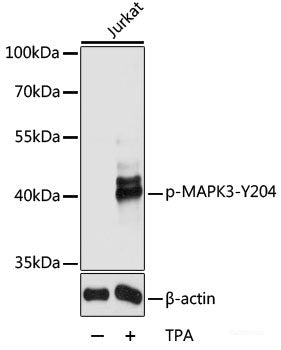
The PHOSPHO-MAPK3(Y204) Polyclonal Antibody exhibits outstanding performance in detecting phosphorylated MAPK3 at tyrosine 204 residue with high specificity and sensitivity. It has been rigorously validated using various experimental approaches, ensuring reliable and reproducible results. This antibody demonstrates minimal cross-reactivity with non-phosphorylated MAPK3 and other related proteins, ensuring accurate detection and interpretation of phosphorylation events.
With its exceptional performance characteristics, the PHOSPHO-MAPK3(Y204) Polyclonal Antibody is an indispensable tool for researchers and scientists studying MAPK signaling pathways and their involvement in various physiological and pathological processes. Its versatility and reliability make it suitable for a wide range of applications, including protein expression profiling, pathway analysis, and drug discovery research.
In summary, the PHOSPHO-MAPK3(Y204) Polyclonal Antibody offers a highly specific and sensitive solution for the detection and analysis of phosphorylated MAPK3 at tyrosine 204 residue. Its exceptional performance characteristics, rigorous validation, and broad applicability make it an invaluable tool for researchers in the field of cellular signaling and molecular biology.
Share